Smoothening Treatments and Hair Extensions: What You Need to Know
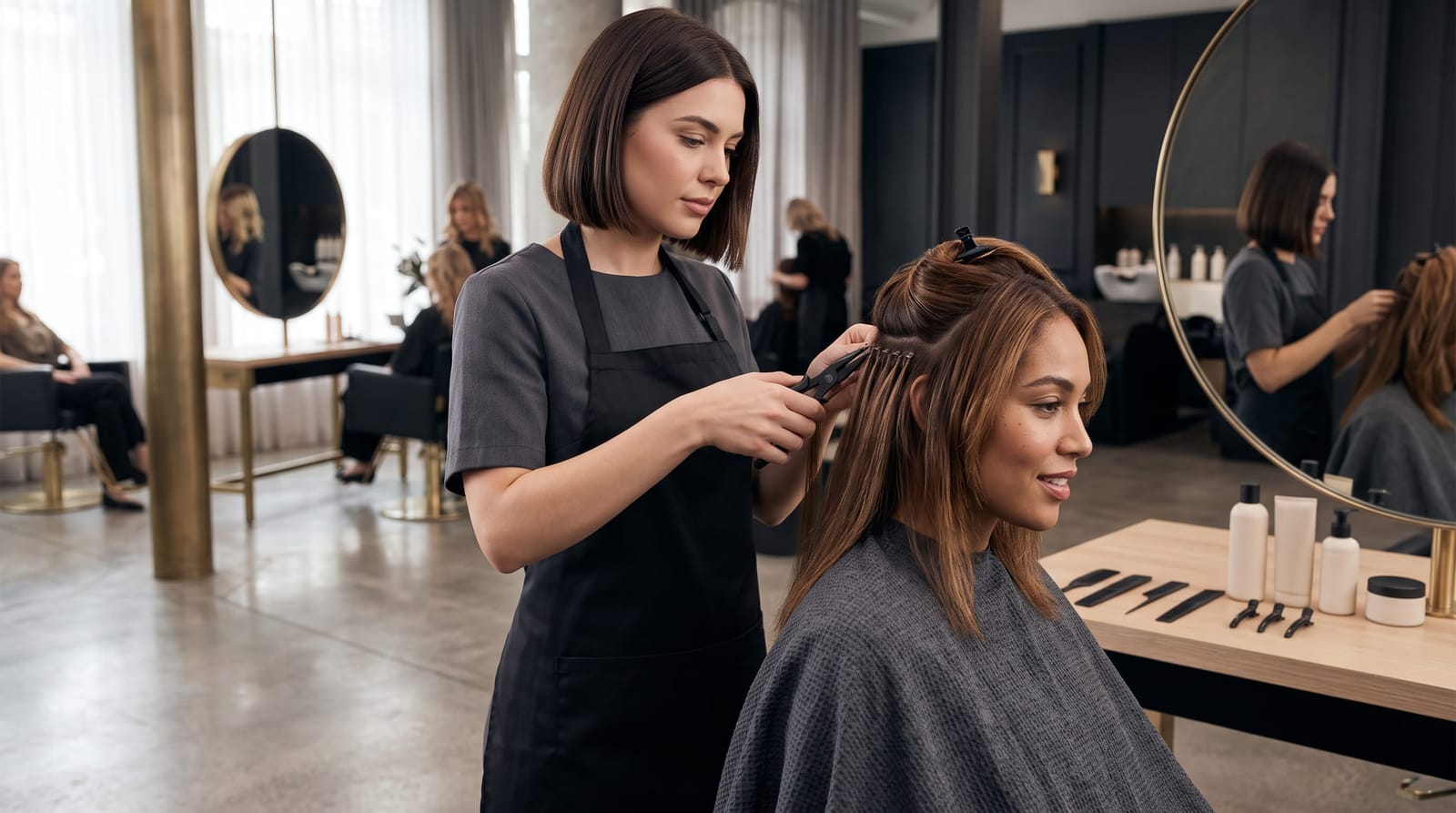
If you're wearing extensions and considering a smoothening treatment, or the other way around, you're asking exactly the right question before you sit in the chair. Combining these two services isn't impossible, but it does require a specific sequence, an experienced stylist, and a clear understanding of how extension hair behaves differently than your natural hair. Whether you're dealing with naturally curly hair or simply want smoother, frizz-free results across your full look, here's what you need to know before booking.
Why Extension Hair and Natural Hair React Differently to Smoothening
When we talk about hair smoothening for curly hair, we're usually talking about treatments, like keratin or Brazilian blowout, that work by temporarily altering the hair's structure using heat and a bonding formula. These treatments rely on the hair's cuticle layer absorbing and sealing the product. Natural hair, even tightly curly or coily hair, has a living cuticle that can respond to this process.
Extension hair is a different story. Whether you're wearing Remy human hair, synthetic blends, or processed extensions, that hair has already been chemically treated during manufacturing. It doesn't have the same cuticle behavior as virgin hair, and in many cases, extension hair has been coated with silicone to give it that initial shine and smoothness. When a keratin treatment is applied over silicone-coated extensions, the formula often can't penetrate properly, which means uneven results, potential product buildup, and in some cases, a shorter-lasting treatment overall.
Studies on keratin treatment longevity suggest results on natural hair typically last 10 to 16 weeks with proper aftercare. On extension hair, especially processed or synthetic blends, that window can shrink to just 4 to 6 weeks, or the treatment may not take evenly at all. This is one of the most important things to discuss with your stylist before committing to either service.
Can You Apply a Smoothening Treatment Over Extensions?
The short answer: it depends on your extension type, and it should always be evaluated by a professional who is trained in both services.
Here's a general breakdown by extension method:
- Tape-in extensions: Most tape-in bonds are heat-sensitive. Keratin treatments require temperatures between 380°F and 450°F during the flat iron sealing step: well above the threshold that can loosen or completely release tape bonds. Applying a keratin treatment over tape-ins is generally not recommended without removing and reapplying the extensions afterward.
- Weft extensions (sewn or beaded): These tend to be more compatible with smoothening treatments since there's no heat-sensitive adhesive involved. A skilled stylist can work through wefted extensions carefully, though the treatment result on the extension hair itself may vary.
- Fusion or nano-bead extensions: Similar concerns to tape-ins: the bonds can be compromised by high heat. These require careful assessment before any smoothening treatment is considered.
- Clip-ins: These can simply be removed before treatment and reapplied after, making them the easiest to work around.
The key variable is always the extension bond. Heat is non-negotiable in most keratin and smoothening processes, so any bond that's vulnerable to temperature is a real concern.
The Right Sequence: Which Service Comes First?
For clients who want both extensions and a smoothening treatment, sequencing makes all the difference. In most cases, the recommended order is: smoothening treatment first, extensions second.
Here's why this order works better for hair smoothening for curly hair specifically. Curly or wavy natural hair that is smoothened first becomes easier to blend seamlessly with straight or wavy extension hair. When the two textures are aligned before extensions are installed, the final look is more cohesive and natural, and the stylist has a cleaner foundation to work with.
After a keratin or Brazilian blowout treatment, most stylists recommend waiting at least 72 hours before any additional chemical service or installation. Some treatments recommend a full two-week wait before extensions are added, particularly if the natural hair needed a significant smoothening result. Rushing this window can compromise both services.
If you're already wearing extensions and want a smoothening treatment, the most honest conversation involves evaluating whether a partial treatment, applied only to the natural hair roots and growth, is a better option than a full-length application. This approach protects the extension bonds while still managing frizz and texture at the root, which is often where curly hair clients feel the most friction between their natural texture and their extensions.
How an Experienced Stylist Manages a Client with Extensions
Not every stylist is equipped to navigate this combination, and that's not a criticism: it's simply a specialization. A stylist with hands-on experience in both smoothening treatments and extension installation approaches this differently than someone trained in only one area.
Here's what that looks like in practice:
- Consultation first, always. Before any service is scheduled, a thorough consultation maps out extension type, age of installation, natural hair condition, and the client's end goal. For curly hair clients, understanding baseline texture is essential: fine curly hair responds to smoothening treatments differently than coarse, thick curls.
- Strand testing on extension hair. An experienced stylist may perform a small strand test on a few extension pieces to see how the hair responds to the formula and heat before committing to a full treatment.
- Customized heat management. Smoothening treatments on fine or previously processed curly hair often require lower flat iron temperatures, around 380°F rather than 450°F, to avoid over-processing. This is even more important when extension hair is part of the equation.
- Honest expectation setting. A great stylist will tell you clearly when combining these services isn't advisable rather than booking a service that could compromise your hair or your extensions. That honesty is a sign of expertise, not limitation.
It's also worth noting that roughly 65% of extension clients report that blending their natural texture with extension hair is one of their biggest ongoing styling challenges, which is exactly why pairing an extension specialist with smoothening expertise matters so much.
Aftercare for Curly Hair That Has Both Extensions and a Smoothening Treatment
Managing hair smoothening for curly hair becomes a longer conversation when extensions are part of the picture. The aftercare window after a smoothening treatment, typically the first 72 hours, requires avoiding moisture, humidity, and anything that bends or creases the hair. With extensions installed, this means being especially gentle with styling and avoiding pulling or tugging on bonds during this period.
Once the treatment has fully set, a consistent routine helps maintain both the smoothening results and the health of your extensions:
- Use a sulfate-free shampoo. Sulfates can strip the keratin treatment faster and also degrade extension bonds over time. Most smoothening treatments lose their efficacy up to 50% faster when sulfate-heavy shampoos are used regularly.
- Apply a leave-in conditioner from mid-shaft to ends, avoiding the extension bonds directly.
- Incorporate a lightweight anti-frizz serum on wash days to manage your natural texture between blowouts.
- Sleep on a silk or satin pillowcase to reduce friction on both your natural hair and extension wefts.
- Schedule a follow-up with your stylist 8 to 10 weeks post-treatment to assess how both services are holding up.
Frequently Asked Questions
Can I get a keratin treatment if I have tape-in extensions?
In most cases, keratin treatments are not recommended directly over tape-in extensions. The high heat required to seal the treatment, typically 380°F to 450°F, can loosen or release tape bonds, causing the extensions to slip. A professional consultation is essential, and in many situations, the extensions should be removed before the treatment is applied, then reinstalled afterward.
How long should I wait after a smoothening treatment before getting extensions installed?
Most smoothening treatments require at least 72 hours before any washing, moisture exposure, or additional services. However, waiting a full two weeks before extension installation is often recommended to ensure the treatment has fully bonded and the hair is stable. Your stylist will advise based on the specific treatment used and your hair's condition.
Will a smoothening treatment help curly hair blend better with straight extensions?
Yes, for clients managing natural curl or wave patterns that contrast with their extension hair, a smoothening treatment applied to the natural hair first can significantly improve blending. Hair smoothening for curly hair reduces frizz and softens the texture at the root, creating a more cohesive look when paired with straighter extension hair.
Does extension hair last as long as natural hair when a keratin treatment is applied?
Generally, no. Extension hair, particularly processed or silicone-coated hair, doesn't absorb keratin treatments as effectively as natural hair. Where keratin results on natural hair can last 10 to 16 weeks, extension hair may see results for only 4 to 6 weeks, or the treatment may not take evenly across the extension length.
The Bottom Line
Combining smoothening treatments with hair extensions is very much possible, but it requires a stylist who understands both services deeply. For clients with curly hair looking for a seamless, polished result, the sequence, timing, and aftercare approach all play a role in how well these two services work together. When done thoughtfully, the combination can genuinely transform how manageable and refined your full look feels every day. To understand the full landscape of smoothening options and how different treatments compare, exploring our broader guide to smoothening treatments is a great next step.