The Complete Guide to Curly Hair Care: Cuts, Styling & Salon Services for Curly Hair in NJ
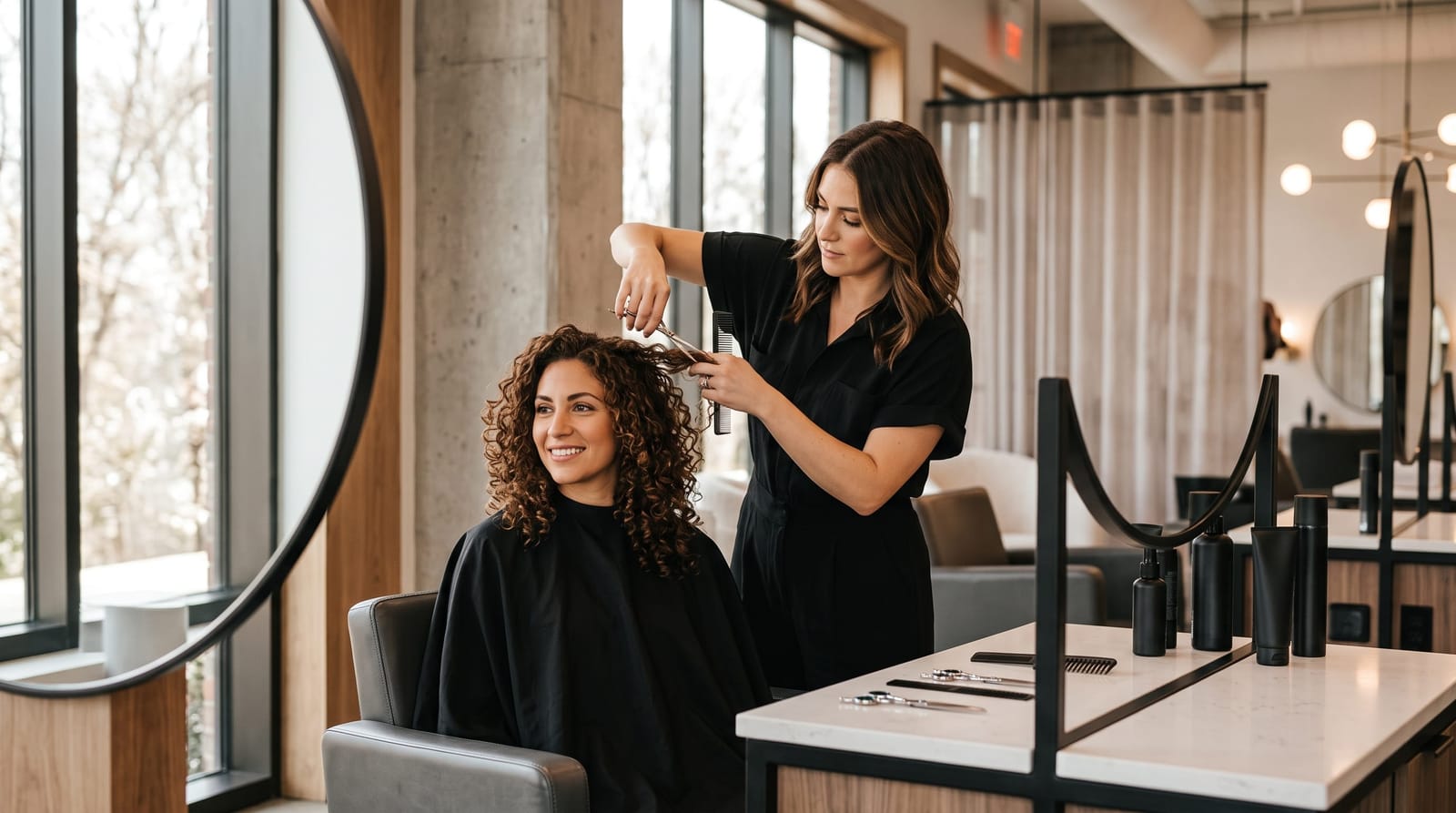
If you have curly hair, you already know the frustration of sitting in a stylist's chair and watching them reach for the scissors, on soaking wet hair, and start cutting straight across like they're trimming a hedge. You walk out, your hair dries, and what was supposed to be a "trim" has turned into something that looks nothing like what you asked for. It's a story that curly-haired women across New Jersey know all too well.
Here's the reality: curly hair is its own category. It behaves differently, it shrinks when it dries, it requires a completely different approach to cutting, coloring, and styling, and most importantly, it responds beautifully when handled by someone who truly understands it. According to a 2022 survey by NaturallyCurly, over 60% of women with curly hair reported feeling underserved by mainstream salons, and nearly 70% said they had received a haircut that made their curls worse, not better.
This guide exists to change that experience for you. Whether you're searching for the best haircuts for curly hair women in North Jersey, trying to understand the difference between a curly cut and a regular haircut, exploring whether a blowout or natural styling service is right for you, or simply looking to build a relationship with a stylist who gets your hair: you're in the right place.
At Substance Salon in North Jersey, we've spent 17 years working with curly and wavy clients, developing techniques, building product knowledge, and refining our approach so that every curly-haired client who walks through our door leaves feeling genuinely seen, and genuinely great.
Let's walk through everything you need to know.
Understanding Your Curl Type: Why It Matters Before You Ever Book an Appointment
Before any stylist touches your hair, both of you need to understand what kind of curls you're working with. The most widely used system, the curl typing system developed by stylist Andre Walker and later expanded by the curly hair community, classifies curls on a spectrum from Type 1 (straight) through Type 4 (tightly coiled), with subcategories A, B, and C within each type.
The Curl Type Spectrum at a Glance
- Type 2 (Wavy): Ranges from loose S-shaped waves (2A) to more defined, frizz-prone waves (2C). These hair types often benefit from lighter layering and products that enhance wave definition without weighing strands down.
- Type 3 (Curly): Includes springy, well-defined curls (3A), tighter corkscrew curls (3B), and dense, voluminous curls (3C). This is the broadest and most varied category, and requires highly individualized cutting and styling approaches.
- Type 4 (Coily): Encompasses tightly coiled zigzag patterns (4A), less defined coils (4B), and very dense, shrinkage-prone coils (4C). These hair types experience significant shrinkage, sometimes up to 75% of actual length, which has major implications for how a haircut should be approached.
Why does curl typing matter so much? Because the best haircuts for curly hair women aren't one-size-fits-all. A cut that looks incredible on a 3A spiral curl can completely overwhelm or underwhelm a 4B coil pattern. Understanding your curl type helps your stylist make informed decisions about where to place layers, how much volume to reduce, and how the cut will behave as it dries and is styled over time.
A skilled curly hair specialist will spend time assessing not just your curl type but also your hair's density (how many strands you have), porosity (how well your hair absorbs and holds moisture), and your personal styling habits. These factors together paint the full picture of what your hair needs.
Dry Cutting vs. Wet Cutting: The Single Most Important Decision in a Curly Haircut
This is one of the most common questions we hear from curly clients who are new to working with a specialist: why is my stylist cutting my hair dry? And more importantly: should they be?
The short answer is that for most curly and wavy hair types, dry cutting is the superior technique. Here's why.
The Case for Dry Cutting
Curly hair has memory. When it's wet, it stretches, loses its shape, and can appear several inches longer than its actual dry length. A stylist cutting wet curly hair is essentially working blind: they're cutting a version of your hair that doesn't reflect how it will actually look, move, and behave when it's dry and styled. This is precisely how those "I only wanted a half inch" haircuts turn into dramatic unplanned transformations.
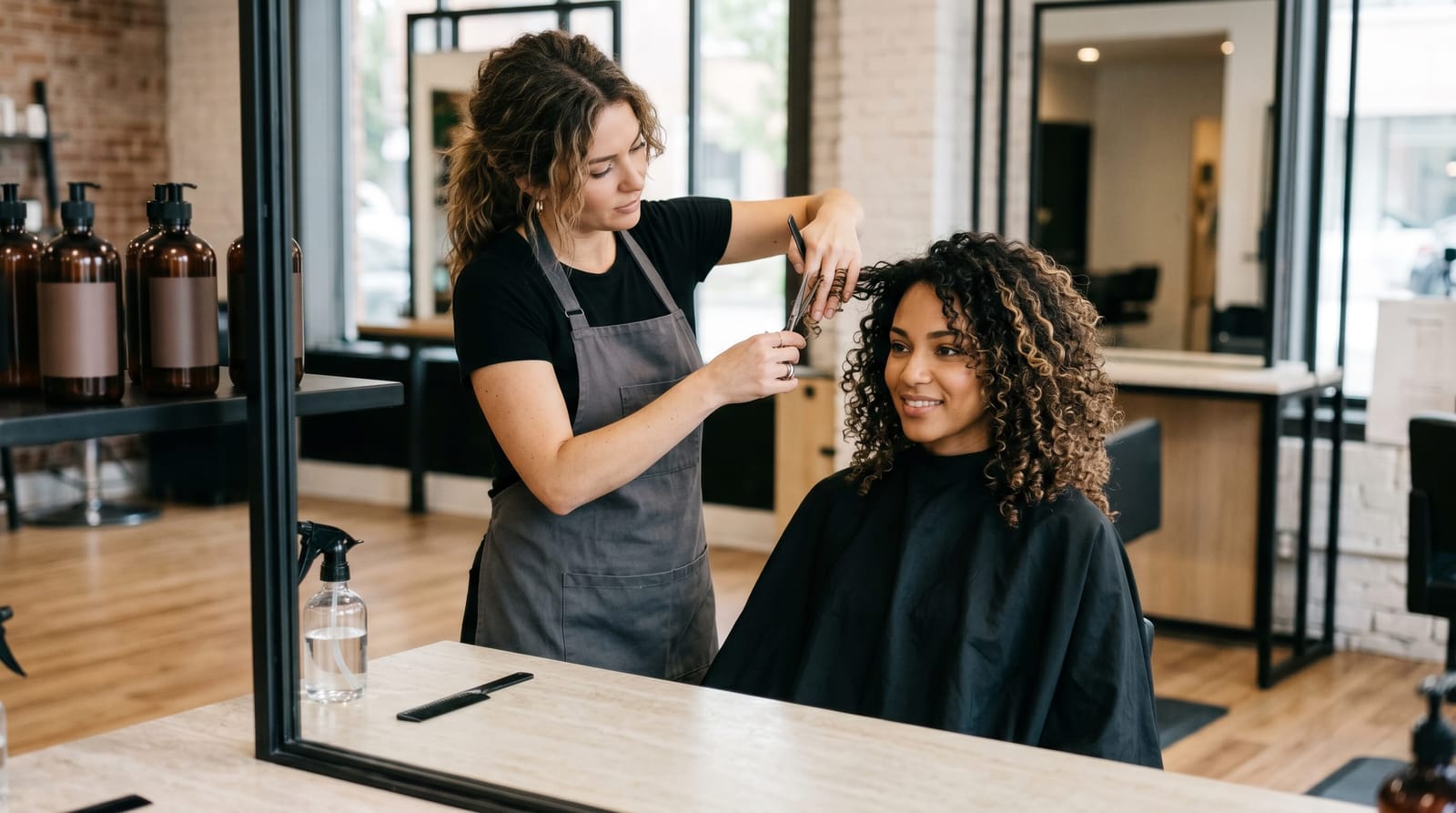
Dry cutting allows the stylist to see your natural curl pattern in its true state. They can see where curls clump, where they separate, where volume accumulates, and where the hair naturally falls. They can personalize each cut to work with the curl, not against it. Many highly trained curly specialists use a technique sometimes called a "curl by curl" cut, where individual curl clumps are shaped one at a time to ensure the final result is cohesive and intentional.
Research published by the Professional Beauty Association indicates that client satisfaction scores are significantly higher for dry cutting techniques among curly-haired clients compared to traditional wet cuts: a finding that aligns directly with what our team at Substance Salon has observed over 17 years of practice.
When Wet Cutting Makes Sense
There are situations where a wet cut or a combination approach, some initial shaping done wet, refinement done dry, makes sense. Certain very fine wavy hair types may respond well to wet cutting for foundational shape. However, for medium to coarse curls, Type 3 and Type 4 textures, or any client who has experienced disappointing results from traditional wet cuts, dry cutting is the method most likely to produce a result that looks as good on day one as it does on day seven.
The Best Haircuts for Curly Hair Women: Styles That Work With Your Natural Texture
When clients ask about the best haircuts for curly hair women, they're often imagining a list of style names to choose from. But the best curly haircut isn't defined by a name: it's defined by how well it's tailored to your specific curl pattern, density, and lifestyle. That said, certain structural approaches consistently perform beautifully on curly hair.
The Layered Curly Cut
Layering is the cornerstone of most excellent curly haircuts. Curly hair, by its nature, wants to stack and expand. Without strategic layering, curls at the bottom of the hair carry the weight of everything above them, pulling out definition and creating a triangular, bottom-heavy shape. Layers redistribute weight, allow curls to spring freely at their natural length, and create movement throughout the entire head of hair rather than just at the ends.
The key is in how layers are cut. Aggressive thinning or razoring can disrupt the curl pattern and create frizz. Instead, point cutting, twist cutting, or curl-by-curl techniques preserve the integrity of each strand while still removing weight where it's needed.
The Curly Bob
The curly bob has seen a major resurgence in popularity, and for good reason. When cut properly, accounting for shrinkage so that the bob sits at the intended length when dry, this style is flattering across a wide range of curl types and requires relatively low maintenance. It works especially well for Type 3 curls and wavier Type 2C patterns. A curly bob can be cut blunt for a more structured look, or cut with internal layers for added movement and lift.
The Diametrix Cut
The Diametrix cut is a specialized technique designed specifically for curly hair. Rather than cutting across hair in uniform layers, the Diametrix method cuts hair at multiple diagonal angles, creating a shape that reduces bulk and weight while allowing curls to coil to their full natural potential. Many clients who have struggled with pyramid-shaped, bottom-heavy curl styles find that the Diametrix approach finally gives them the rounded, voluminous-at-the-top shape they've been chasing.
The Curly Pixie
For clients looking for a truly low-maintenance cut with maximum impact, the curly pixie is a bold, beautiful option. It works particularly well for looser wave patterns (Type 2B and 2C) and softer spirals (Type 3A). A well-executed curly pixie uses natural curl movement to create volume and texture, so even a shorter style feels expressive and full of personality.
Long Curly Cuts With Shape
Not every curly client wants shorter hair, and that's entirely valid. Long curly hair can be absolutely stunning, but it requires intentional shaping to avoid the "growing out" look that can happen when curls are simply allowed to extend without any structural consideration. Strategic long layers, shaped ends, and occasional weight removal keep long curly hair looking intentional and polished rather than overgrown.
Curly Cut vs. Standard Haircut: What's Actually Different
If you've ever booked a haircut at a general salon and left feeling like the stylist just didn't quite get it, you're not imagining things. There are real, substantive differences between a curly-specific haircut and a standard salon haircut, and understanding those differences helps you advocate for yourself when booking services.
A standard haircut is typically performed on wet hair, using horizontal sections and uniform cutting lines designed to create a consistent length and shape. This technique works beautifully for straight to slightly wavy hair, where the wet and dry versions of the hair behave similarly. For curly hair, it's a fundamentally mismatched approach.
A proper curly haircut accounts for shrinkage (cutting longer than the intended dry length to compensate for how much the curl will pull up), curl clumping patterns (some areas of the head curl tighter than others, and a good cut honors those differences), and overall shape when dry and styled, not just when wet and combed flat.
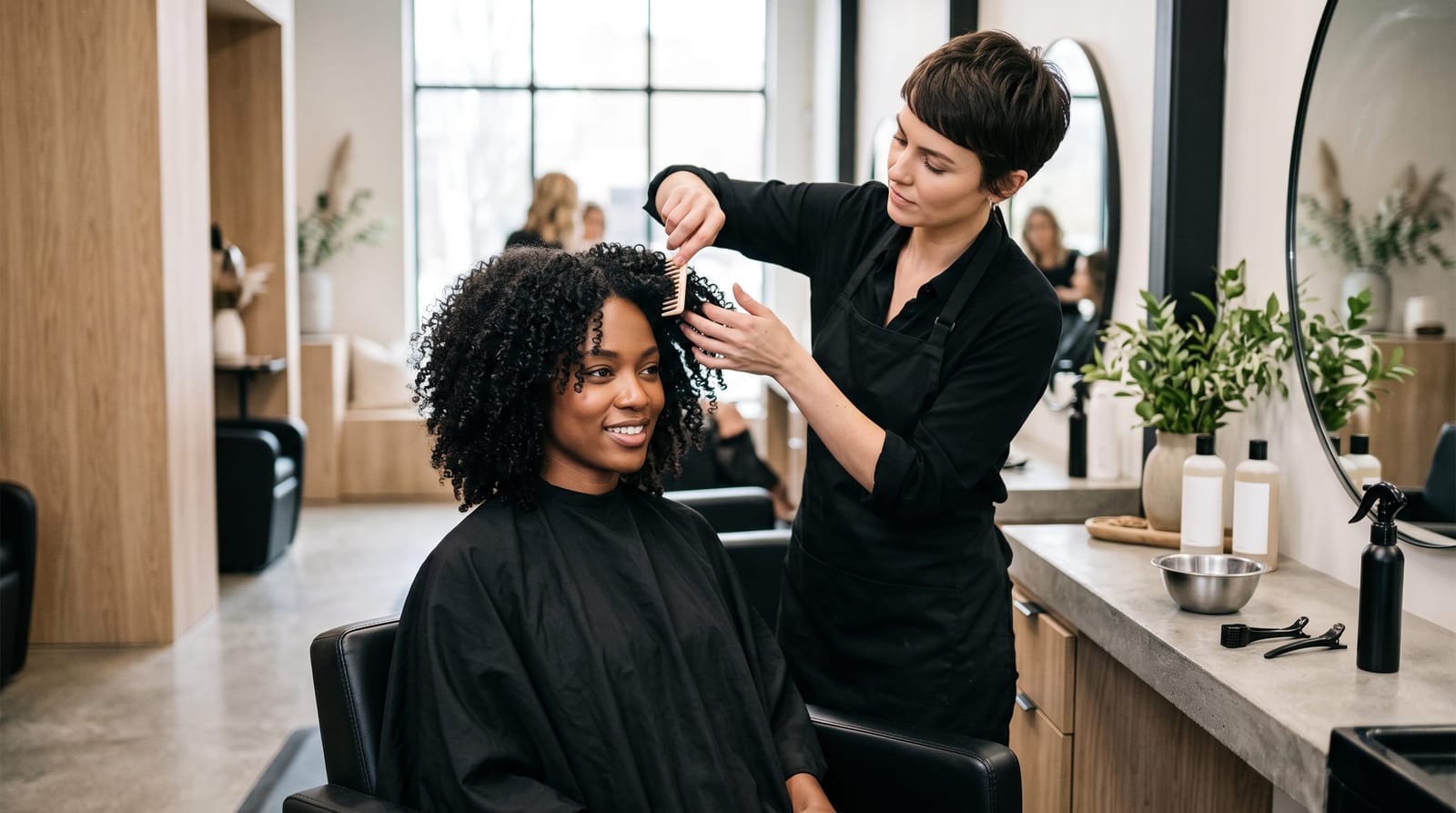
Beyond technique, a curly cut consultation should include a conversation about how you actually wear your hair. Do you diffuse? Air dry? Do you prefer stretched styles or fully coiled natural texture? Do you color your hair, and how does that affect your curl pattern? These questions shape the cut as much as the scissors do.
According to NaturallyCurly's State of Curly Hair report, 65% of curly-haired respondents said they had to travel more than 30 minutes to find a stylist they trusted with their curls: a statistic that speaks directly to the shortage of genuinely trained curly specialists in most markets.
Blowouts and Natural Styling for Curly Hair: Understanding Your Options
Not every curly client wants to wear their curls every day. Life is varied, personal style evolves, and sometimes you want a smooth, polished look without committing to a chemical treatment. That's where blowout services come in, and understanding how they work on curly hair specifically helps you make the right choice for your hair and your lifestyle.
The Curly Hair Blowout
A professional blowout on curly or wavy hair uses heat tools and professional tension-based techniques to temporarily relax and smooth the hair into a straighter, more voluminous style. The key word is temporary: a blowout is a styling service, not a chemical alteration. Your curls return when you next wash your hair.
For curly clients, blowouts require more skill and more time than they do on straight hair. The stylist must manage tension carefully to avoid disrupting the curl's internal protein structure, use appropriate heat protectant products, and work in sections that honor the hair's density and texture. When done well, a curly hair blowout produces a sleek, full style with beautiful movement, and no damage to the curl pattern.
Natural Styling Services
On the other end of the spectrum, many curly clients prefer to enhance and celebrate their natural texture rather than temporarily change it. Natural styling services at a curl-focused salon might include wash-and-define appointments (where a stylist uses your preferred products and techniques to set your curls as they would look at their best), diffusing services, or twists and braid-outs for clients who want a stretched, defined look without heat.
The right choice between a blowout and natural styling depends on your lifestyle, your hair's health, and your personal style preferences. Neither is inherently better: they serve different purposes and different moments.
Hair Smoothening Treatments for Curly Hair: What to Know Before You Book
Hair smoothening treatments, which include options like keratin treatments and various professional smoothening systems, are among the most requested services from curly clients who want a longer-term reduction in frizz and curl intensity without a permanent chemical change.
These treatments work by temporarily altering the hair's internal bonds using heat and a conditioning protein formula, resulting in smoother, more manageable hair for anywhere from 8 to 20 weeks depending on the specific treatment and your hair type. For curly and wavy clients, the results can range from full straightening to a softened, frizz-free version of your natural wave pattern: depending on the formula used and the intention going in.
It's important to understand that smoothening treatments are not permanent, they're not one-size-fits-all, and they require careful consideration of your hair's overall health, color service history, and maintenance routine. A skilled stylist should always perform a thorough consultation before recommending a smoothening treatment, and should be honest about what results you can realistically expect based on your specific texture.
For curly clients who love their curls but want to reduce volume and frizz for easier morning styling, certain lighter smoothening formulas can be used strategically to soften the curl rather than eliminate it: preserving the character of your hair while making your daily routine significantly more manageable.
Curly Hair Color: How Professional Color Works Differently on Textured Hair
Curly and wavy hair interacts with color differently than straight hair does, and understanding why helps you get more beautiful, longer-lasting results. The structural characteristics of curly hair, including its higher porosity in many cases, the way light hits and reflects off coiled strands versus straight ones, and the concentration of color at different points along the curl, all affect how color is applied, develops, and ultimately looks.
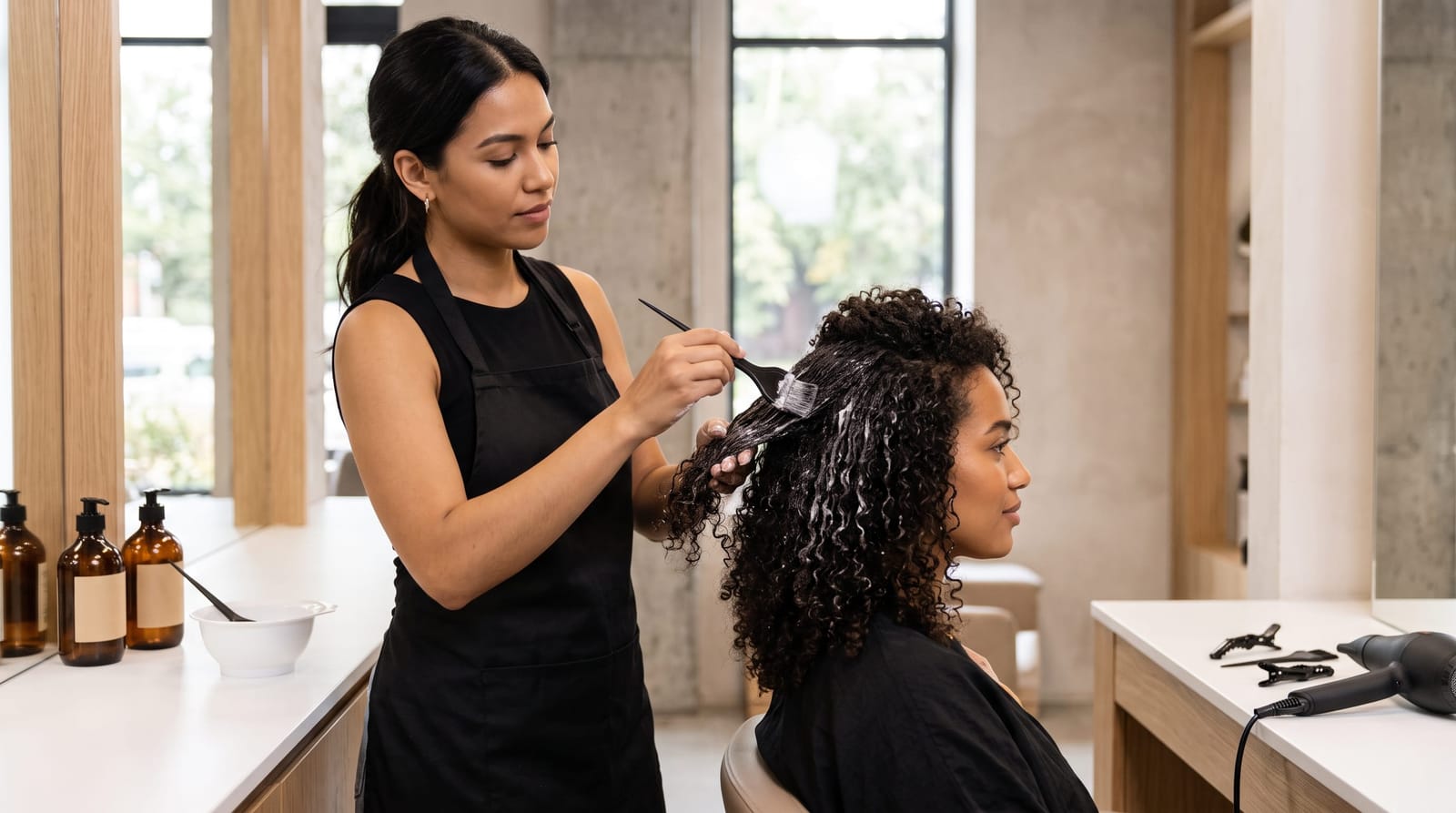
Techniques like balayage and highlights, when applied to curly hair, require a stylist who understands how curls clump and separate. Highlights painted on stretched, straight sections may appear in entirely different places once the curl returns to its natural shape. A colorist experienced in curly hair knows how to place color so that it illuminates the curl beautifully rather than creating odd, disconnected patches of lightness.
Additionally, chemical services like color or lightening can affect the porosity and strength of curly hair, which directly impacts curl definition. The best approach is always a collaborative one: understanding your color goals, your curl health, and designing a service plan that achieves both without compromise.
Building a Relationship With a Curly Hair Specialist: What to Expect and What to Ask
Finding the right stylist for your curly hair is genuinely one of the most valuable investments you can make in your overall hair health and happiness. But it's also more than a transaction: it's a relationship that develops over time, built on trust, honest communication, and mutual understanding of your hair's behavior and your personal goals.
What to Look for in a Curly Hair Specialist
A genuine curly hair specialist should have documented training in texture-specific cutting and styling techniques, not just general cosmetology school, which rarely covers curly hair in meaningful depth. Look for stylists who actively seek out continuing education in curl-specific methods, who use intentional language about dry cutting and curl typing in their consultations, and whose portfolio includes a diverse range of curl types and styles.
Ask questions before you book. How do they approach the consultation for a new curly client? Do they cut curly hair dry or wet, and why? What products do they use and recommend for your curl type? A confident, knowledgeable specialist will welcome these questions: they're a sign that you're an informed client who takes your hair seriously.
What a Great Curly Hair Appointment Looks Like
A strong curly hair appointment begins with a thorough consultation that covers your hair history, styling routine, product preferences, lifestyle, and goals. Your stylist should examine your hair in its natural state, ideally after you've worn it naturally, not freshly blown out, to accurately assess your curl pattern and density. The cut itself should feel intentional and collaborative, with the stylist explaining their approach and checking in as they work. And before you leave, you should feel genuinely equipped with product and styling guidance that helps you recreate the result at home.
At Substance Salon, we've built our curly hair approach on exactly this kind of relationship: one appointment, one conversation, one curl at a time. Our 17 years of experience working with curly and wavy clients across North Jersey has taught us that every head of hair is genuinely different, and the best results always come from listening first.
Deep Dive Topics: Explore Every Dimension of Curly Hair Care
This guide gives you the foundation, but curly hair is a rich, nuanced topic with entire dimensions worth exploring in greater depth. Below, you'll find our focused deep-dive resources that expand on the most important aspects of curly hair care, from finding the right salon to understanding how color, smoothening, and styling services work specifically on textured hair.
- Finding the Right Curly Hair Salon in NJ: Not every salon is equipped to serve curly clients well, and knowing what to look for makes all the difference. Our guide to finding a curly hair cut salon NJ walks you through exactly what questions to ask, what red flags to watch for, and what a genuinely curl-focused salon looks like from the inside.
- Color on Curly Hair: Balayage, Highlights, and Texture: Color on curly hair is a specialized art. Our in-depth guide on balayage on dark hair brunette textures covers how professional colorists approach placement, tone, and technique differently when working with curls and coils.
- The Curly Girl Method and Professional Salon Services: The Curly Girl Method has a dedicated following, but how does it interact with professional salon services? Our breakdown of best haircuts for curly hair women through a CGM lens covers what your stylist should know about your routine before they pick up the scissors.
- Hair Smoothening for Curly Hair: What You Need to Know: Thinking about a smoothening treatment? Our complete guide to hair smoothening for curly hair covers the most common treatment types, what to realistically expect for your curl pattern, how to prepare, and how to maintain results.
- Blowout vs. Natural Styling for Curly Hair: Two very different approaches, two very different results, and both can be exactly right depending on the client. Our comparison of curly hair blowout vs natural styling helps you understand what each service involves and which one aligns with your hair goals and lifestyle.
Conclusion: Your Curls Deserve a Specialist Who Understands Them
Curly hair is not difficult: it's just different. And different requires a different approach, a different level of training, and a different kind of conversation. The best haircuts for curly hair women aren't found on a style chart or a trending post; they're created in a chair with a stylist who has taken the time to understand your curl pattern, your lifestyle, and your vision for your hair.
The key takeaways from this guide: curl type matters enormously and should shape every decision your stylist makes. Dry cutting is the gold standard for most textured hair because it respects how curls actually behave. The right cut, whether that's a layered style, a curly bob, a Diametrix cut, or something entirely customized, should work with your natural pattern, not fight against it. And smoothening, color, and styling services all have curly-specific considerations that make specialist experience not just preferable, but essential.
At Substance Salon, we've been serving the curly-haired community of North Jersey for 17 years, and we believe that every client who walks through our door with curls deserves to leave feeling like the absolute best version of themselves. If you're ready to experience what a truly personalized curly hair appointment feels like, we'd love to meet you and your curls.
Book your consultation with Substance Salon today and let's start building the curly hair relationship you've been looking for.